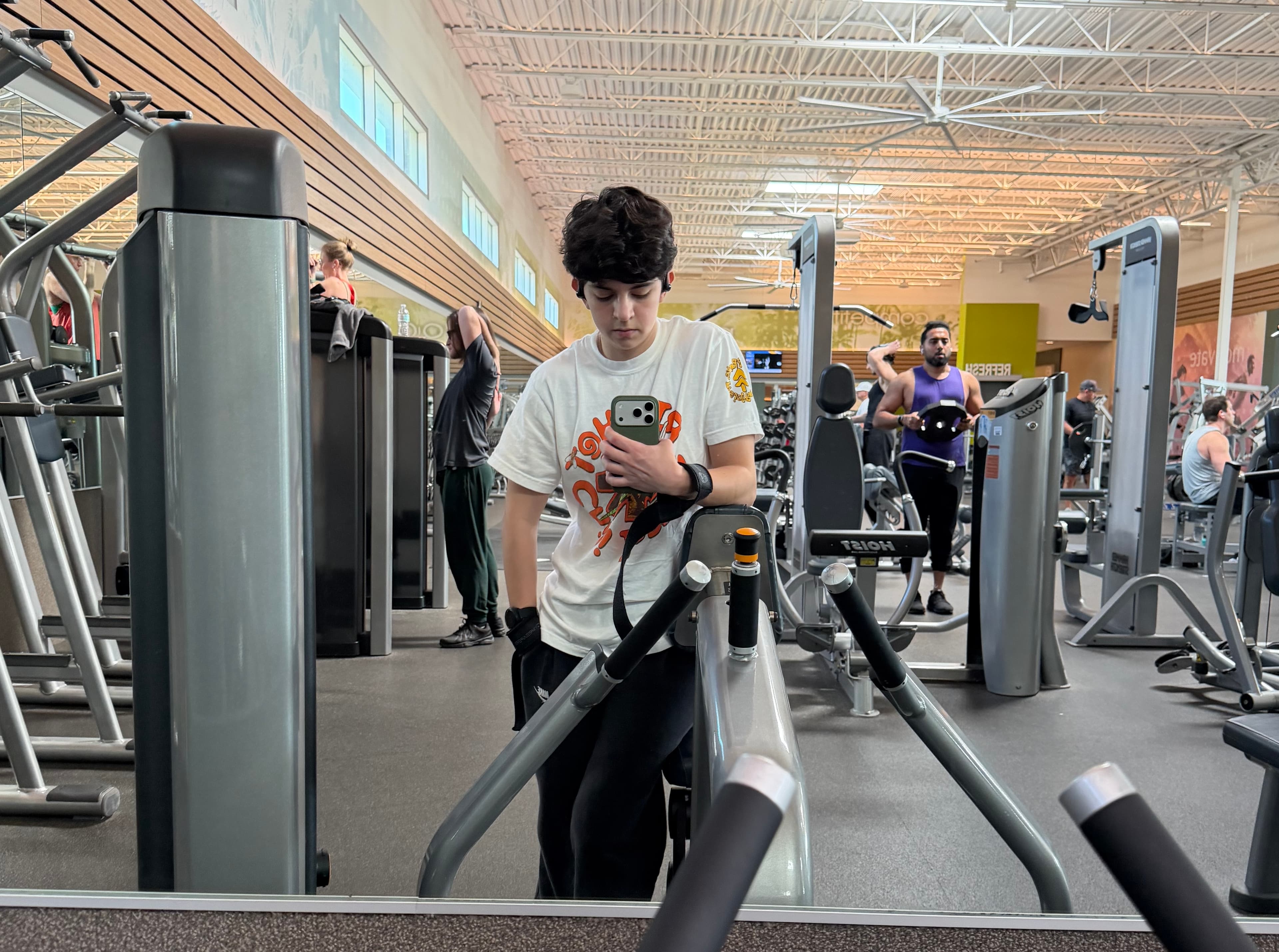
Since struggling to lift a 45-pound barbell in middle school athletics, weightlifting has always been something I've dabbled in, but never fully committed to. In high school soccer, we lifted twice a week in offseason, but the routine was always changing up and it was rare we did the same exercise twice in a month. Outside of school, I went to a local gym for a few months while I had a membership there for self-defense lessons, but again, I wasn't consistent with it. My sophomore year of college, I lifted almost daily for about 6 months, but after getting COVID, quit due to low energy levels.
Each of these bouts of lifting, I did something wrong; whether it was poor management of my fatigue, changing my split constantly, or poor diet, I never made much progress. I often blamed this on poor genetics and a slow metabolism. After losing 20 pounds last year from understanding diet in a more scientific way, I no longer felt limited by factors I couldn't control, and spent hours poring over YouTube, blogs, and other sources to grasp how to become stronger and increase muscle mass. I settled on a push-pull-legs split, and have tweaked that a few times. I got a gym membership, and since then, I've made significant progress. When I lifted consistently my sophomore year, my bench press max was 95 pounds and it was a struggle to get the weight up. Yesterday, I bench pressed 95 pounds six times.
Less volume, same gains?
Studies show that training muscle groups two or three times a week is superior to only training them once a week (though whether there is a significant difference between 2 or 3 times a week is unknown). While weekly volume (defined as number of sets per week per muscle group) can contribute to improved muscle mass, other studies have noted that there might be a "ceiling effect" where more sets beyond a certain point might be less beneficial. Studies and trainers alike also note that weekly volume highly depends on your individual context. As such, I am tracking my weekly volume to understand my strength and recovery and manage fatigue better. With my current workout split, most muscle groups are getting between 8-15 sets per week. This is a noticeable decrease from weeks before, where most muscle groups were getting 15-20 sets per week.
There are disagreements in the literature on how to calculate weekly volume, because while bench press is primarily a chest exercise, it also involves your triceps, so some count bench press sets for triceps while others do not. I decided to weight those "secondary" sets as 0.5 sets for those secondary working muscles. So, while my biceps, quads, and triceps have higher volume, this is mostly because of exercises where they are secondary workers. I've also cut back on sets for my chest, as that is a stronger point for me and I've found that my chest gets more fatigued, so I only do 8 sets over the course of two sessions.
Here is my volume, comparing week 8 to week 11:
Moving forward, I will continue to keep track of what muscle groups are continuing to see progressive overload, what muscles are still fatigued on their second session of the week, and other indicators of fatigue (particularly CNS fatigue) and muscle growth. The decrease from Week 8 to Week 11 was not influenced by fatigue in the moment, but based on what I've read from trainers and studies mentioned above and my experiences with CNS fatigue in my sophomore year. I also switched from 6 days in the gym per week to 5 days per week because my mom started going with me and wanting to spend less time in the gym overall. I am now running a PPLxUL split (push-pull-legs-rest-upper-lower-rest), which helped cut down on upper body volume.
Progressive overload doesn't always progress
I've seen improvement in just about every lift I've done, but what has surprised me is the nonlinearity of strength gains. I have kept my exercise selection and the order of my exercises relatively the same (I've swapped some here and there just because I don't like the exercise or I feel it's not effective for me) to track progressive overload correctly, but there are still plateaus. These are likely due to energy levels caused by sleep, stress, and fatigue. Additionally, calculating 1-rep maximums uses both reps and load, so if I do 80 pounds for 8 reps one week and then increase to 85 but only get 6 reps the next week, the Brzycki formula calculates a higher 1RM for the former, despite me increasing the load. This accounts for some of the dips in strength, as I increased the load in that session and therefore couldn't do as many reps, but then the next session I'm typically able to do the same number of reps at that new, higher weight.
By keeping my exercise selection and prioritizing both of these movements at the beginning of each session, I can accurately determine my progress on these two lifts and see exactly where I plateaued over time. For example, my bench press was stuck for a while at 85 for 6, and now is stuck around 90. Last week, I only got 95 for 4, so I dropped the weight to do 90 for 6. This week I've made progress, getting 95 for 6. My lat pulldown, similarly, was stuck around Session 11-13, before I overcame the plateau and I've been seeing decent progress since. I attribute that progress to a day where I ate a lot of carbs out at a restaurant, which made me feel energized the next day, where I did lat pulldowns.
Rethinking my reasoning on high repetitions
As for how many repetitions (reps) I do per set, I've shifted from having my rep ranges vary between doing some 6-10 reps on certain exercises, and 12-15 reps on others. I had read that there were different rep ranges for strength (lower reps) and hypertrophy, or the increase in muscle size (higher reps). However, research has demonstrated that lower rep ranges also work just as well for muscle hypertrophy, while having the additional benefit of strength gains. This video also does a great job summarizing the impact of different loads on hypertrophy and motor unit recruitment. As mentioned by this creator, intensity is much more important than a specific number of reps. I've found that I recover faster from mid-range rep (typically between 6-8) sets with heavier weight, and it's less time consuming. However, with certain lifts (like cable lateral raises), going heavier means I'm only able to get in about 4 reps and they're uncomfortable, whereas going 5 pounds heavier means I can get 10-12. In this case, I do go for the higher rep range, but still keep it below 15 to avoid too much fatigue. This video discusses the impact of higher rep ranges on fatigue.
I've updated my training to reflect this more updated research, and I feel that it has allowed me to increase the intensity of my working sets and recover better. From my first week to my most recent week, I've essentially eliminated higher rep ranges from my training. One exception with this is leg raises, where I'm only able to get close to failure around 20 reps. As such, I will likely phase this movement out of my lifting routine in favor of a decline crunch or a cable crunch where I can more easily load weight and utilize progressive overload.
How do I track this data?
I've been using the app Hevy to track my workouts to remember what weight I used the last time I did particular exercises, and while the app is great for tracking during a workout, many of the features that would provide further insight into my workout data are behind a paywall. Since I know all of the formulas required and exactly how I'd like the data displayed, instead of paying for the subscription, I've been developing a Streamlit application to display this data. While this is a work in progress because I'd still like to make uploading workout data less tedious and provide other insights, you can check it out here. The data is stored in a database file and the data wrangling is performed in the background using sqlite3 in Python.
What's next?
For years, I've set New Years' resolutions surrounding my personal strength. I've come close, but never reached them. This year, I set out to bench 100 pounds (check!) and do a single pull-up (also check!). These goals seemed so far out of reach, and yet within 3 or so months of consistent training (with some vacations in between) I was able to achieve both. I'd come close to the former in 2022 with a bench 1RM of 95 pounds, but hadn't come anywhere near a pull-up.
Next up, I'm hoping to achieve 10 pull-ups and a bench press of a plate (135 lbs). I'm not sure if these are achievable by the end of the year, but I know that if my previous goals were achievable, these are too!
In the meantime, I'm going to keep working on my Streamlit app, keep tracking my workouts, and hopefully post an update around the end of the year!